
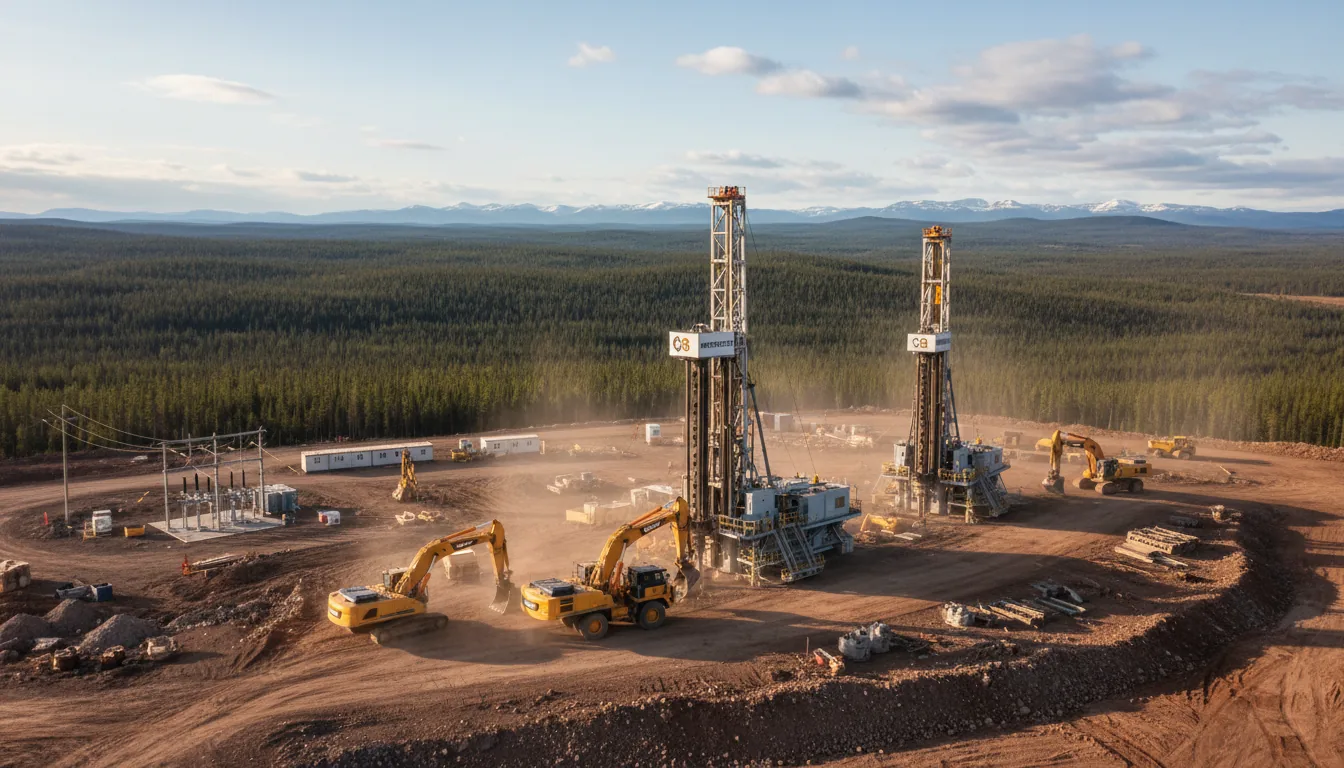
Direct Drive Systems for Drilling & Production Equipment
Permanent magnet direct drive for the rotating equipment that defines wellsite availability — top drives, drawworks, mud pumps, rotary tables, workover winches, fracturing skids and artificial lift — with site assessment, integration and commissioning support.
Where drives carry the load on a wellsite
Drilling and production equipment operates far from workshops, under variable load and in harsh ambient conditions. Drive selection in these stages is a reliability and logistics decision as much as an efficiency decision.
- 01
Drilling
Top drive, drawworks, rotary table and mud circulation equipment operate together under variable load, in remote locations and across a wide ambient temperature band.
- 02
Well completion & stimulation
Fracturing and pumping spreads traditionally driven by diesel engines through torque converters — a long mechanical chain with emissions and noise at the wellsite.
- 03
Workover & intervention
Workover rig winches and automated pipe handling equipment require strong short-term overload capacity in a compact, transportable package.
- 04
Artificial lift
Screw pumps, beam and tower pumping units and electric submersible pumps run continuously at low speed, where belt-and-reducer drivetrains dominate maintenance.
- 05
Fluid handling & injection
Mud, water injection and transfer pumping loads that run for long campaigns and respond directly to speed control rather than throttling.
Where permanent magnet direct drive is applied
A permanent magnet motor wound for the driven speed removes the reducer, torque converter and high-speed coupling from the drivetrain. On a rig or a production site that matters most where service access is limited, torque rather than speed defines the machine, and downtime is expensive. It is an application decision, not a blanket replacement for every geared drive.
What a wellsite drive evaluation requires
An assessment starts from the equipment and its duty, not from a catalogue. The following information is what we ask for before stating whether a direct drive conversion is technically and commercially appropriate.
- Equipment and duty
- Rig or production equipment type, hook load or pump rating, and the operating profile it runs against.
- Torque and speed
- Working and break-out torque, operating speed range and any short-term overload requirement.
- Existing drivetrain
- Prime mover (electric or diesel), torque converter, gearbox ratio, belt or chain arrangement and maintenance history.
- Power supply
- Available voltage and capacity at the site — 600 V / 690 V rig power, generator sets, or medium-voltage service — and any existing VFD.
- Environment
- Ambient temperature range, altitude, humidity, dust and salt exposure, and hazardous-area classification requirements.
- Mechanical envelope
- Space, weight and transport limits at the drive location, including mast, skid or trailer constraints.
- Controls and monitoring
- Existing control system, whether centralized or remote monitoring is required, and any unmanned operation objective.
- Regulatory scope
- Applicable standards, certification expectations and the inspection regime the equipment must satisfy in your jurisdiction.
Representative drive data
Values below are representative datasheet figures for the permanent magnet drive equipment classes used in drilling and production applications. Final selection is confirmed against the equipment duty during engineering assessment.
Full motor family parameter ranges — line-start, variable-speed, low-speed direct drive and motorized pulley — are consolidated in the motor selection reference.
| 01Transmission | AC variable-frequency motor, direct drive |
|---|---|
| 02Rated hook load | 2 250 – 9 000kNDatasheet range across five frame sizes. |
| 03Speed range | 0 – 187 up to 0 – 260rpm |
| 04Working torque | 30 000 – 134 000N·m |
| 05Break-out torque | 50 000 – 201 000N·m |
| 06Rated power | 335 / 500 / 746 / 1 080 / 1 600kW |
| 07Power supply | 600 VAC 50/60 Hz690 VAC 50/60 Hz optional. |
| 08Ambient temperature | −45 to +55°C |
| 09IBOP rated pressure | 105MPa |
| 01Reference voltage | 600 VNon-standard ratings available by selection. |
|---|---|
| 02Rated power | 250 – 1 200kW |
| 03Rated speed | 405 – 700rpm |
| 04Rated efficiency (100 % load) | 96.3 – 97.8% |
| 05Power factor | 0.96 – 0.98 |
| 06Rated torque | 3 946 – 22 743N·m |
| 07Torque margin | 1.5 × ratedMaximum torque multiple; locked-rotor multiple 1.6–1.7. |
| 08Rated noise | 95dB(A) |
| 09Arrangement | Single- or twin-motor direct drive on the pump |
| 01Reference voltage | 600 V |
|---|---|
| 02Rated power | 345 – 865kW |
| 03Speed range | 0.6 – 165 (to 75/152 on high-torque models)rpm |
| 04Rated torque | 23 000 – 94 000N·m |
| 05Rated efficiency (100 % load) | 93.9 – 97.1% |
| 06Power factor | 0.89 – 0.98 |
| 07Torque margin | 1.4 – 1.5 × ratedLocked-rotor multiple 1.5–1.8. |
| 08Rated noise | 95dB(A) |
| 01Drill floor height | ≤ 7 / 7–12 / 12–14 / ≤ 14m |
|---|---|
| 02Tubular length | 13.7 (R3) or 19.6 (DR2)m |
| 03Maximum safe working load | 45 – 72kN |
| 04Drive power | 75 – 119kW |
| 05Drive type | Permanent magnet direct drive, electric |
| 01Arrangement | Direct drive head on the polished rod |
|---|---|
| 02Drivetrain removed | Induction motor, belt drive, reducer |
| 03Stable operating speed | 20 – 200rpm |
| 04Braking | Soft brake with star-resistance controlled stop |
| 05Power-loss behaviour | Controlled reverse rotation for pressure reliefIntended to limit rod-string damage on sudden outage. |
| 06Control | Intelligent controller, variable-frequency operation |
| 01Replaces | Diesel engine and hydraulic torque converter |
|---|---|
| 02Drive type | Variable-speed permanent magnet motor, direct to pump |
| 03Speed range | Wide adjustable range, high torque at low speed |
| 04Measured power saving | > 17%Manufacturer field measurement; site-specific verification required. |
| 05Integration | Centralized control and remote monitoring interface |
Assess a drive application at your wellsite
Send us the equipment, duty data and existing drivetrain arrangement. We will tell you whether direct drive is suitable, what the conversion involves, and what information is still missing.