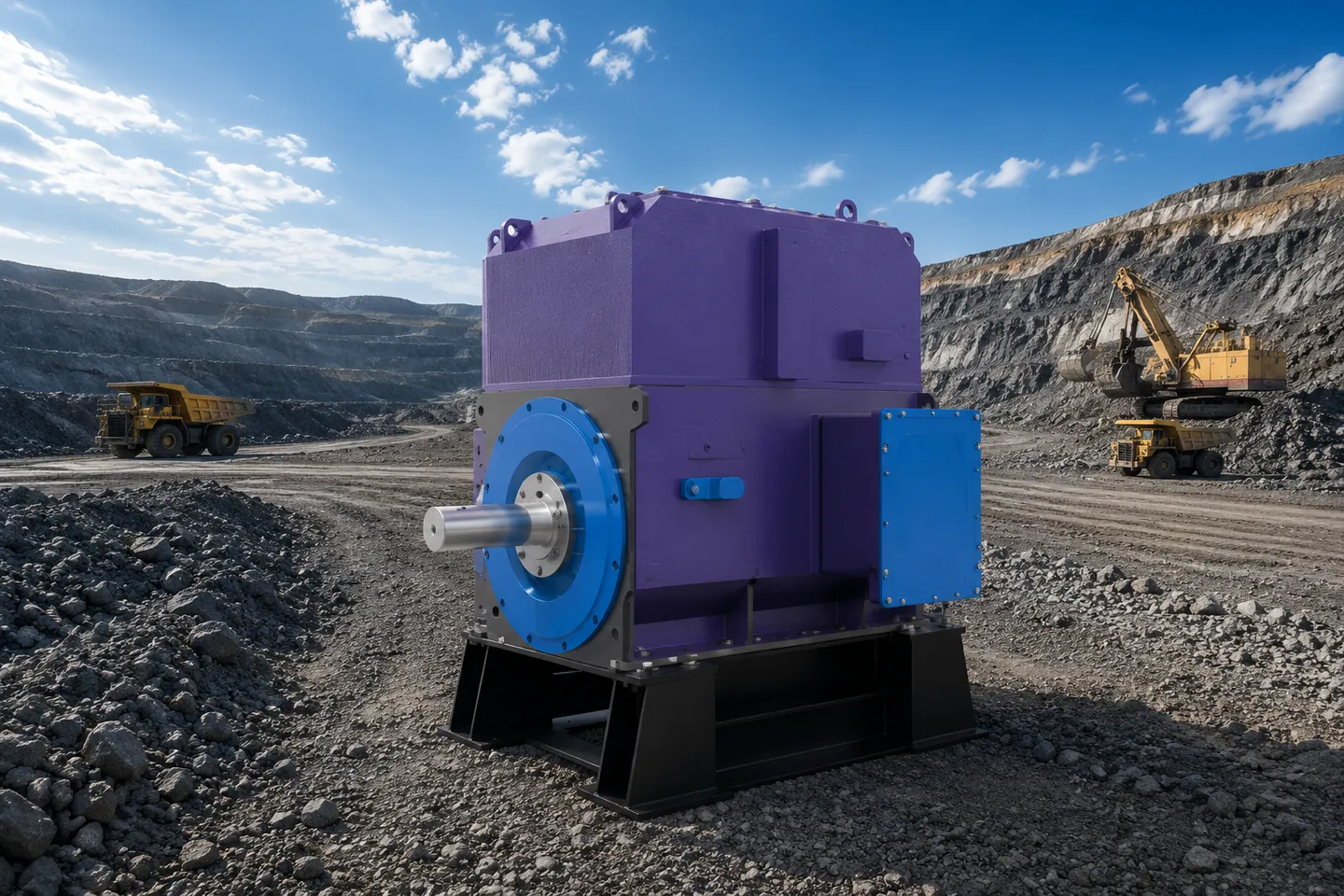
Mining Technology
Industry Insights

PMDD Motors in African Copper and Gold Mining: Surviving Harsh Environments Where Gearboxes Fail

brooks yee
May 16, 2026
13 min read

PMDD motors improve reliability and energy efficiency by eliminating mechanical gearboxes that frequently fail in demanding copper and gold extraction operations. Implementing a PMDD motor Africa mining harsh environment solution reduces maintenance costs and operational downtime through a more robust; direct drive design. These systems are increasingly vital for remote sites where traditional drive components struggle to withstand extreme temperatures and dust.


When a gearbox fails 200 kilometers from the nearest service depot in the Copperbelt, the cost is never just the repair bill. It is the lost production, the emergency logistics, the crew hours, and the cascading delays that follow. For engineers and operations managers running copper and gold extraction in sub-Saharan Africa, that scenario is not hypothetical; it is a recurring operational reality that conventional drive systems were never truly designed to prevent. Permanent Magnet Direct Drive motors eliminate the mechanical intermediaries where those failures originate, and in environments defined by extreme heat, pervasive dust, high altitude, and remote isolation, that distinction becomes a survival factor. This article examines exactly how PMDD architecture performs under African mining conditions, what the downtime economics actually look like, and how to specify the right system for your operation.

Why African Mining Environments Destroy Conventional Drive Systems

Large-scale underground mining conveyor loaded with ore in operation under dramatic industrial lighting
African mine conveyors run continuously under conditions that accelerate conventional drivetrain wear.

Picture a conveyor drive station at a Zambian copper concentrator in January. Surface ambient temperature sits at 47C before noon. The air carries ultra-fine copper and silica particulate at concentrations that reduce visibility to a few meters. Fifty meters underground, the same drive system faces humidity levels approaching saturation as ventilation air picks up moisture from active headings. These conditions do not alternate politely; they stack. A sealed enclosure rated for a temperate European installation will see its internal temperature climb well past design limits within weeks of commissioning in this environment.

The consequences are not theoretical. A documented case from African mining operations recorded total bearing collapse in a conveyor gearbox after only 1,200 hours of service, directly attributable to 3.2% silica contamination breaching the lubrication circuit. For context, a comparable installation in a temperate climate might log 20,000 hours before a first bearing intervention. The African environment does not simply shorten equipment life; it compresses failure timelines by an order of magnitude.

This is the operational baseline across the DRC Copperbelt, Zambia's copper corridor, and the South African gold belt, not a set of worst-case outliers. What makes it particularly punishing for conventional drive systems is the logistical layer beneath the technical one. When that bearing collapses, the nearest tier-1 replacement supplier may be three days away by road across borders that impose their own unpredictability. Every hour of that transit compounds the production loss.

Conventional geared drive architecture carries a component count designed for environments with controlled contamination, stable thermal loads, and reliable supply chains. None of those conditions exist here. Understanding why PMDD motor Africa mining harsh environment performance differs requires first understanding just how systematically the African operating environment exploits every lubricated contact point and every enclosure penetration in a traditional drive train.

What PMDD Architecture Removes from the Failure Equation

Disassembled traditional gearbox with scattered components contrasted against a single compact PMDD motor assembly
Fewer components means fewer failure points, especially critical at remote African mine sites.

The operational picture described above points to a direct question: what exactly fails, and can those failure points be removed rather than simply hardened? PMDD architecture answers this at the component level.

In a conventional geared conveyor drive, the power transmission path runs through a motor, a flexible coupling, a multi-stage gearbox, output shaft seals, a lubrication circuit, and an oil cooler, each requiring its own maintenance attention and each presenting a pathway for contamination. Count the lubricated contact points across that assembly in a dusty African installation and the total typically falls between 12 and 18. Each one is a scheduled service item, and any one of them can initiate an unplanned failure.

A PMDD motor eliminates this chain by coupling the permanent magnet rotor directly to the driven load shaft. There is no gearbox, no intermediate coupling, no oil circuit, no cooler, and no gear seals to maintain. The lubricated contact count drops to near zero. Understanding how PMDD technology works makes clear that this is not a marginal improvement but a fundamental reduction in the number of things that can go wrong.

The financial grounding for this matters. Industry research on gearless drive systems documents that gear maintenance activities alone account for up to 5% of original investment costs in traditional installations. In a remote Zambian copper operation, that figure carries an additional multiplier: when a bearing seal fails, the replacement part may be three days away by road, and the production loss accumulates for every hour of that wait. Removing the component removes the logistics exposure entirely.

Heat, Dust, and Altitude: How PMDD Performs Where PMSMs Struggle

Thermal camera view comparing heat generation in a traditional gearbox versus a cool-running PMDD motor under equal load
Thermal imaging shows PMDD systems running significantly cooler than geared alternatives at equivalent loads.

Removing the gearbox is necessary, but it is not sufficient on its own. The motor itself must survive where conventional permanent magnet motors routinely fail, and this distinction matters more than most procurement specifications acknowledge.

General-purpose PMSMs carry a thermal management liability in harsh environments. To maintain winding temperatures within operating limits at high ambient conditions, they typically require active cooling systems: forced-air ducting, liquid cooling circuits, or heat exchangers. Each of those systems introduces enclosure penetrations, moving parts, and maintenance intervals. In a high-dust environment, a forced-air cooling inlet becomes a direct contamination pathway regardless of its filtration rating. Research published through NCBI confirms that PMSMs in mining environments carry elevated costs specifically because of these special cooling systems and the materials required to support them. The cooling system designed to protect the motor becomes one of its most vulnerable subsystems.

PMDD designs built for PMDD motor Africa mining harsh environment conditions approach thermal management differently. By coupling directly to the load and running at lower base speeds matched to the driven equipment, the motor avoids the gear-step speed multiplication that generates disproportionate heat in the stator windings. Lower rotational speed at equivalent torque output means lower core losses and reduced heat generation from the outset. This allows sealed enclosures rated to IP66 or above, using passive thermal dissipation through the housing structure rather than active airflow, which eliminates the penetration points that dust and humidity exploit.

Altitude adds another variable that is easy to overlook in specifications written from temperate engineering offices. Several southern African plateau operations sit above 1,500 metres, where air density is measurably lower. For traditional motors relying on forced-air cooling, reduced air density directly degrades heat transfer capacity, requiring derating or supplemental cooling. A passively managed PMDD installation with a sealed housing is largely indifferent to this effect, since its thermal path runs through the motor structure rather than through the ambient air.

Downtime Economics at African Copper and Gold Operations

The thermal and dust management case for PMDD is compelling on engineering grounds alone. The financial argument is what converts it into a procurement decision.

At a South African gold operation, an unplanned stoppage on a production-critical conveyor or mill feed system can erase tens of thousands of rand per hour in revenue. At a Congolese copper concentrator, the equivalent dollar figure is similarly severe. The research is unambiguous: equipment availability is one of the largest financial levers in African mining, and a single hour of downtime on a primary production circuit can halt output entirely. Most African operations are still running reactive or preventive maintenance strategies, neither of which accounts for the compressed failure timelines that the environment forces on conventional drive components.

The supply chain multiplier is where the cost truly accumulates. A bearing failure at a remote Zambian site does not just cost the production hours while the machine is stopped; it costs the three or more days of cross-border logistics required to get the replacement part to site. Every hour of that transit window is a direct revenue loss that dwarfs the component price.

PMDD's contribution here is structural. By reducing the lubricated contact point count from the 12 to 18 of a conventional geared drive to near zero, the architecture extends realistic mean time between maintenance interventions from a typical six-month cycle to 24 months or longer. That change reduces the total number of planned logistics events, the emergency spare parts exposure, and the technician hours required on site.

This last point matters in African jurisdictions where experienced maintenance technicians are in genuine shortage and mine sites often rely on small rotating teams covering large equipment fleets. Simpler drive architecture means routine inspections require less specialized knowledge, which widens the pool of personnel qualified to conduct them and reduces dependence on infrequent specialist visits.

Intelligent Monitoring as the Second Layer of Harsh-Environment Protection

Engineer adjusting parameters on an illuminated industrial control panel with digital displays in low-light environment
Real-time drive monitoring enables remote fault detection before failures escalate at isolated mine sites.

Extended service intervals change the logistics equation, but they do not eliminate the need to know what is happening inside a drive system between those intervals. That is where intelligent condition monitoring becomes the second layer of protection, and where the distinction between PMDD hardware and a generic predictive maintenance discussion matters.

In an underground Zambian copper heading or an enclosed overland conveyor running through a dust cloud, visual inspection tells an operator very little. Embedded sensors change this entirely. Winding temperature monitors track thermal load in real time, flagging early-stage insulation stress before it reaches a failure threshold. Vibration signature analysis identifies bearing anomalies or rotor imbalance at amplitudes that are undetectable by any surface inspection. Power draw trending reveals load asymmetries that precede mechanical deterioration by weeks or months. Together, these data streams create a continuous health picture of the drive system without requiring anyone to open an enclosure in a 47C, dust-laden environment.

MotiraTech integrates this monitoring capability directly into its PMDD solutions, connecting drive health data to remote operations teams through field technical support for remote operations. For African mine sites where specialist technicians are rotational staff appearing on irregular schedules, this is not a convenience feature; it is a fundamental shift in how reliability is managed. An anomaly detected remotely during the gap between site visits can trigger a targeted intervention rather than an emergency response, which is the difference between a planned parts order and a three-day cross-border logistics crisis.

Copper and Gold Applications Where PMDD Has Demonstrated Results

The monitoring layer described above is most valuable when it is paired with drive hardware that has already demonstrated performance in the application types African mining demands. Three categories stand out.

Overland and underground conveyor drives. Continuous high-load conveyor operation in the DRC Copperbelt combines the worst of every variable covered in this article: sustained thermal load, abrasive dust at concentrations that defeat standard seals, and the recurring failure mode of gearbox oil contamination. Silica and copper particulate entering a lubrication circuit degrades viscosity, accelerates bearing wear, and produces the kind of catastrophic failure documented at 1,200 hours in the research. PMDD removes the lubrication circuit from the equation entirely, making the primary contamination failure mode structurally impossible rather than just harder to trigger.

Ball mill and SAG mill drives at copper concentrators. Gearless direct-drive technology for large grinding mills has been proven at scale in comparable harsh-environment operations internationally, with published industry data confirming meaningful reductions in CO2 output and maintenance burden compared to ring-gear alternatives. The operating principle is identical to what PMDD delivers at conveyor scale: direct coupling eliminates the pinion gear, ring gear, and associated lubrication systems that represent the highest-frequency failure points in concentrator circuits.

Hoist and winding systems at deep gold shafts. South African gold mines operating below 2,000 metres require hoisting systems capable of delivering high peak torque with zero backlash during load transitions. Legacy DC motor hoists require regular commutator and brush maintenance, work that demands specialist technicians and generates extended planned outages. Permanent magnet direct drive produces full torque from zero speed without mechanical commutation, reducing both the maintenance task list and the precision shaft control risk that backlash introduces at depth.

Selecting and Specifying a PMDD System for an African Mine Site

Field technician in safety gear performing diagnostics on an industrial motor system at an outdoor remote mining site
On-site commissioning support ensures PMDD specifications are validated against actual site conditions.

The application cases above point to a consistent pattern: PMDD succeeds in African mining conditions when the specification process accounts for the actual operating environment rather than a temperate-climate equivalent. For a procurement engineer or operations manager building a specification from scratch, five questions define the critical parameters.

IP rating for your dust and humidity profile. Ultra-fine silica and copper particulate at DRC Copperbelt concentrations will defeat IP55 enclosures over time. Surface conveyor drives in high-dust corridors and underground installations in saturated headings both warrant IP66 as a minimum; IP67 or IP68 should be evaluated where periodic flooding or high-pressure washdown is realistic.

Ambient temperature range including worst-case surface summer peaks. A nameplate rating based on 40C ambient will derate in service at 47C. The specification should reference the site's actual recorded summer maximum, not a regional average, and thermal derating calculations should be verified against that figure before procurement.

Altitude and its effect on thermal derating. Southern African plateau sites above 1,500 metres require explicit derating review for any motor with active air cooling. Passively cooled PMDD enclosures are less sensitive to this variable, but the calculation should still be confirmed.

Load profile characteristics. Constant-torque conveyor applications differ meaningfully from crusher feed drives subject to surge loading. Shock load tolerance and peak torque capacity need to be specified against the worst realistic feed event, not average throughput.

Grid conditions at the point of connection. Remote sites running on diesel generation introduce voltage instability and harmonic distortion profiles that differ substantially from utility grid supply. Drive electronics must be specified to tolerate those conditions without nuisance tripping or accelerated component degradation.

MotiraTech works with international mining clients from its Richmond, BC engineering base to develop specifications that address each of these Africa-specific variables directly. Through MotiraTech industrial solutions, the team supports clients from initial feasibility and specification development through commissioning and ongoing remote monitoring, which directly reduces the skills and logistics burden that remote African operations carry throughout the drive system's operational life.

Conclusion: Matching Drive Technology to the Reality of African Mining

The specifications described above are not refinements to a standard procurement process; they are the starting point for operating successfully in a context that breaks conventional assumptions at every level. The African mining environment is not a temperate industrial setting with added dust. It is a fundamentally different operating reality, one where failure timelines compress by an order of magnitude, logistics multiply every unplanned event, and skilled technician availability cannot be taken for granted.

PMDD motor Africa mining harsh environment performance holds precisely because the architecture eliminates the lubricated contact points, enclosure penetrations, and maintenance complexity that these conditions punish most severely. Fewer components means fewer failure modes, and fewer failure modes means fewer cross-border parts orders arriving three days too late.

The forward trajectory sharpens the stakes. Global copper demand driven by electrification will draw increasing output from the DRC Copperbelt, Zambia, and South Africa across the next two decades. The drive systems commissioned today will carry that production load for 15 to 20 years. Choosing technology matched to that reality is an engineering decision with consequences measured in operational decades, not maintenance cycles.


Transitioning to PMDD technology offers a robust solution for African mining operations facing extreme conditions and frequent gearbox failures. By simplifying the drivetrain, mines can achieve higher uptime and lower maintenance costs. If you want expert help evaluating these systems for your specific site requirements, MotiraTech Industrial Solutions Inc. is available to consult on your hardware needs. Understanding the mechanics is a great starting point, so we recommend reviewing our guide on PMDD Explained as you plan your next upgrade.