Mining Technology
Industry Insights

Why Mining Conveyor Systems Are Beginning to Reduce Dependence on Gearboxes

brooks yee
May 15, 2026
13 min read

Mining operations are transitioning to gearless conveyor drive mining systems to eliminate mechanical failure points and reduce maintenance costs associated with traditional gearboxes. These direct drive systems enhance ore throughput and energy efficiency by utilizing advanced motor technology, which simplifies installation and improves long-term reliability for high-capacity belt systems.


If your mine's conveyor system has ever gone down mid-shift because of a gearbox failure, you already understand the true cost of mechanical complexity at scale. Unplanned downtime, expedited parts sourcing, and the ripple effect on downstream production are problems that conventional drivetrain designs have handed mining operations for decades. The industry is now moving toward a fundamentally different approach, and the shift is gaining serious traction. In this article, we break down exactly how gearless conveyor drives work, why permanent magnet and electrically excited synchronous motors are replacing gearboxes on high-demand belts, which drive type suits your specific operating environment, and how to evaluate whether the economics justify the transition for your operation.

The Short Answer: What Is a Gearless Conveyor Drive?

A gearless conveyor drive replaces the conventional drivetrain, which typically consists of a motor, couplings, brake, and gearbox, with a single slow-running synchronous motor that delivers torque directly to the drive pulley. By eliminating the gearbox entirely, the drivetrain loses several mechanical stages that introduce friction losses, maintenance requirements, and failure points.

Two motor types dominate gearless conveyor drive mining applications today: permanent-magnet synchronous motors (PMSM) and electrically excited synchronous motors (EESM). Both operate on the same core principle of direct torque delivery at low shaft speeds, but they differ in how the rotor magnetic field is generated and how they perform across varying load and environmental conditions.

MotiraTech specializes in the PMSM variant known as permanent magnet direct drive (PMDD). For a deeper look at how that technology is configured, see our PMDD motor technology explained page. The sections that follow cover why this shift away from gearboxes is accelerating across the mining industry.

Why Gearboxes Have Been a Long-Standing Liability in Mining

Disassembled traditional gearbox with scattered components contrasted against a single compact PMDD motor assembly
Conventional gearboxes introduce dozens of failure points that direct-drive systems eliminate entirely.

That shift away from gearboxes does not happen without cause. For decades, the conventional gearbox-based conveyor drivetrain has been one of the most maintenance-intensive assemblies in the mining plant, and the consequences of failures are rarely contained.

A typical gearbox-driven conveyor system involves a high-speed motor running through a fluid coupling, a multi-stage gearbox with helical or bevel-helical gear sets, intermediate shafts, and flexible couplings on either side, all connected to the drive pulley. Each mechanical interface in that chain is a potential failure point. Bearings wear. Gear teeth fatigue under shock loading from material surges. Couplings go out of alignment. The lubricating oil degrades, attracts contamination, and must be changed on fixed schedules regardless of actual condition.

This complexity becomes particularly consequential in Canadian mining contexts. Gearbox oil viscosity changes dramatically between a summer afternoon and a -30C January startup at a northern Ontario or Yukon operation. Cold, thickened lubricant increases startup drag, elevates thermal stress, and accelerates wear in the early minutes of each shift. At high-altitude or remote sites in BC or the territories, getting a replacement gearbox to site, given typical lead times of 16 to 40 weeks for large units, can effectively strand a conveyor circuit for an entire season.

Conveyor systems account for close to 80% of total energy consumption in many mining operations, which means that mechanical losses through gearbox inefficiency are not a rounding error; they are a material operating cost. When high-load transients from uneven feed or blockage events hammer the gear train, the repair economics become significant very quickly.

How a Permanent Magnet Motor Replaces the Gearbox on a Conveyor

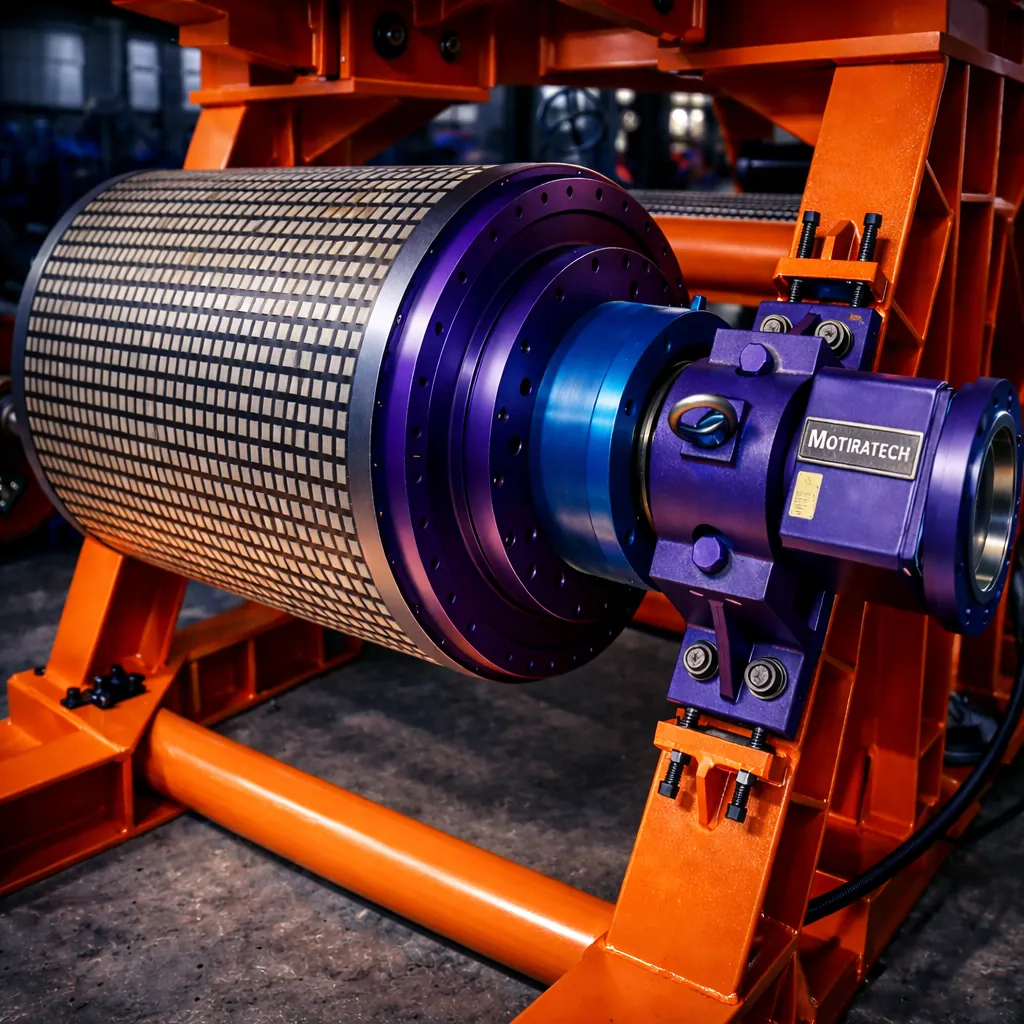
PMDD motor assembly mounted directly to a conveyor drive shaft with no gearbox visible between motor and pulley
Direct coupling to the drive shaft is the defining feature of a PMDD conveyor installation.

The mechanical answer to the gearbox problem is straightforward in principle. A PMDD motor is built around the drive pulley shaft itself, with the rotor integrated directly into the pulley structure. Because the motor operates at the same low RPM that the belt requires, typically in the range of 20 to 80 RPM depending on pulley diameter and belt speed, there is no speed mismatch to resolve. The gearbox existed solely to bridge the gap between a high-speed induction motor and a slow-turning pulley; remove that gap, and the gearbox has no function to perform.

The rotor carries arrays of permanent magnets that generate a stable magnetic field without any external excitation supply, brushes, or slip rings. The stator windings surround the rotor, and a variable-frequency drive controller regulates the electrical frequency delivered to those windings, which is how speed and torque are precisely managed across the full operating range. Torque response is fast and controllable, which matters during belt loading transients where conventional drivetrains are most vulnerable.

What disappears from the drivetrain is significant: the gearbox and its pressurized oil system, the fluid coupling, intermediate shafts, and the alignment-sensitive flexible couplings that connect them. Each of those eliminated interfaces carried alignment tolerances that drifted over time and under thermal cycling. Without them, the mechanical path from motor to belt is direct and rigid.

That rigidity carries a secondary benefit. Reduced drivetrain vibration lowers the cyclic stress on the belt carcass and pulley bearings, extending service life on components that are expensive to replace and difficult to access at remote sites. For a detailed look at how the motor itself is configured, see our PMDD motor technology explained page.

PMSM vs. EESM: Choosing the Right Gearless Drive Motor for Your Mine

With the gearbox removed from the drivetrain, the motor itself becomes the defining engineering decision. Both PMSM and EESM configurations can deliver direct torque at the low shaft speeds a conveyor requires, but they arrive at that outcome through different means, and those differences carry real consequences for Canadian mine operators.

A PMSM, and by extension a PMDD system, uses rare-earth permanent magnets in the rotor to establish the magnetic field. No external excitation supply, brushes, or slip rings are required. That simplicity translates directly into a more compact motor envelope, higher part-load efficiency, and a drivetrain with fewer electrical interfaces to maintain. In cold-climate applications, the absence of excitation winding systems also means one fewer subsystem vulnerable to condensation and insulation degradation during extended cold soaks at outdoor installations.

An EESM generates its rotor field through a wound excitation winding fed by an external DC supply. The key advantage is adjustability: operators can tune the field strength independently of speed, which can be useful for reactive power management at very high power ratings. At power levels above roughly 10,000 kW per drive, the economics of rare-earth magnet materials can also shift toward EESM. The technology also carries a longer installed history in large grinding mill drives, which gives some procurement teams additional confidence in the reference base.

For most new gearless conveyor drive mining projects in Canada, particularly in the 2,500 to 10,000 kW range that covers the majority of overland and underground conveyor applications, PMDD technology typically delivers better total-cost-of-ownership. Higher efficiency at partial load, reduced auxiliary system complexity, and cold-weather startup performance without oil or excitation preheating all favour the PMDD configuration. MotiraTech's systems are built on this platform.

Criteria

PMSM / PMDD

EESM

Excitation supply required

No

Yes (external DC)

Part-load efficiency

Higher

Moderate

Cold-climate startup

No viscosity or winding preheat needed

Excitation system requires attention

Adjustable field control

Limited

Yes

Preferred power range

Up to ~10,000 kW

Above ~10,000 kW

Rotor simplicity

High

Moderate

The Real Maintenance and Uptime Numbers Behind Gearless Drives

Maintenance checklist on clipboard showing PMDD motor section marked complete beside a dense traditional drive service schedule
Fewer scheduled maintenance tasks means more uptime and lower lifecycle operating costs.

Those motor selection decisions carry measurable consequences once a system is in the ground. The Antapaccay copper mine in Peru offers one of the most cited benchmarks in gearless conveyor drive mining literature: a 5,260 tonne-per-hour overland system commissioned in 2012 that has sustained availability above 99%. That figure matters not just as a headline but as a planning input. A conventional gearbox-equipped drive on a comparable system typically targets availability in the low-to-mid 90s once scheduled oil changes, coupling inspections, and unplanned gear failures are factored in. The delta between 93% and 99% availability is not abstract; on a high-tonnage circuit, it represents tens of thousands of tonnes of lost production per year.

On the energy side, published benchmarks show reductions in the range of 5% versus traditional gear-driven configurations at equivalent throughput. For a Canadian operation running a large conveyor circuit around the clock, that margin compounds into material savings over a 20-year asset life, particularly as industrial electricity rates in BC and Ontario continue to climb.

For remote Canadian operations, the more immediate value is often logistical. Eliminating routine oil changes removes a scheduled fly-in fly-out maintenance event that, at a northern site accessible only by air or winter road, can cost more in mobilization than the oil service itself. Removing gearbox oil systems also eliminates the environmental liability of a lubricant leak into a northern watershed, a consequence that carries regulatory exposure well beyond the cost of the cleanup.

Spare parts inventory shrinks substantially as well. A gearbox-based drivetrain at a remote site typically requires stocked bearings, seals, gear sets, coupling inserts, and filtration components. The PMDD drivetrain's reduced part count translates directly into lower working capital tied up in a parts room that may be 500 kilometres from the nearest distribution hub. These operational advantages become most pronounced at power levels above 2,500 kW per drive pulley, where the cost and complexity of conventional drivetrain infrastructure scales faster than the gearless alternative.

Are Gearless Conveyor Drives Suitable for Underground and Cold-Climate Mining?

PMDD-equipped mining equipment operating in heavy snow and frost with ice-covered surfaces at a northern latitude industrial site
Cold-climate reliability is a key advantage for Canadian mines operating through harsh winters.

Those logistical and uptime advantages take on a different character when the conveyor moves underground or into a Canadian winter environment. In both cases, the constraints are physical and the consequences of drivetrain failures are more severe than at a surface installation in a temperate climate.

Underground, the governing constraints are ventilation capacity and physical envelope. Every kilowatt of heat generated by a drivetrain must be removed by the mine's ventilation system, and ventilation is one of the largest operating cost line items in a deep underground mine. A conventional gearbox-plus-motor assembly generates heat from gear mesh friction, bearing losses, and oil churn across multiple mechanical stages. A PMDD motor, running without those intermediate stages, converts a higher proportion of input power directly into torque at the pulley. The reduced heat load per installed kilowatt is a concrete engineering advantage in a development where ventilation airflow is finite and expensive to augment. The compact form factor of the PMDD assembly also matters in confined drive headings where a conventional drivetrain train would require significantly more excavated volume.

The cold-climate case is equally direct, and it is one that international competitors rarely address with any operational specificity. At a northern Ontario, Quebec, or territorial mine site, a gearbox sitting in an outdoor drive station at -30C overnight has congealed oil that dramatically increases startup drag and thermal stress in the first minutes of operation. Conventional installations manage this with heated enclosures, oil pre-warming circuits, and extended warm-up sequences, all of which add infrastructure, energy consumption, and procedural complexity to every startup event.

A PMDD motor has no oil system to manage. At -30C or below, the startup sequence is electrically controlled through the VFD without any dependence on lubricant viscosity reaching an operating threshold. For energy efficiency solutions for mining operations in BC's high-altitude interior, the Yukon, or Labrador's open winter conditions, that characteristic is not a minor convenience; it eliminates an entire category of cold-weather failure mode that maintenance crews at remote Canadian sites deal with on a recurring basis.

Intelligent Monitoring: The Digital Layer That Makes Gearless Drives Smarter

Engineer adjusting parameters on an illuminated industrial control panel displaying real-time drive system diagnostics
Real-time monitoring platforms turn raw sensor data into actionable predictive maintenance intelligence.

Cold-weather startup reliability addresses one category of operational risk. The digital control layer built into modern gearless conveyor drive mining systems addresses several more, and it is where the technology has advanced most rapidly in the past decade.

At the controls level, the VFD does more than regulate speed and torque. In multi-pulley conveyor configurations, where drive stations may be distributed across several kilometres of overland system, the software actively balances load sharing between pulleys in real time. If one drive station begins carrying a disproportionate share of belt tension due to material distribution or thermal effects, the control system redistributes torque across the string before mechanical stress accumulates to a damaging level. Soft-start sequencing, which controls how torque is ramped during belt startup to prevent surge loading, is similarly managed at the software layer rather than through mechanical limiters.

Belt slip detection is another function that benefits directly from the sensor density a PMDD installation carries. Because the motor's rotational state is continuously monitored with high resolution, deviations between commanded and actual belt speed are identified in milliseconds rather than discovered during a visual inspection.

The more significant shift is in how that continuous data stream changes maintenance practice. Time-based service intervals, which are essentially a proxy for condition in the absence of better information, are replaced by condition-based interventions triggered by actual readings from temperature sensors, vibration accelerometers, and electrical performance metrics. An off-site engineer reviewing remote asset health data can identify a developing bearing anomaly and schedule a targeted repair before it becomes an unplanned shutdown, without dispatching a technician to a site that may require charter flight access.

MotiraTech's intelligent monitoring capabilities are built around this model. For a broader view of how industrial monitoring strategies apply across mining and heavy industrial assets, see our industrial energy insights page.

When Does a Gearless Conveyor Drive Make Economic Sense?

That digital maintenance layer changes the risk calculus considerably, but it does not change the underlying capital decision. The practical question most mine operators arrive at is direct: at what point does a gearless conveyor drive make financial sense compared to a conventional drivetrain?

The crossover for capital cost parity generally falls above 2,500 kW per drive pulley. Below that threshold, a well-specified gearbox-based drivetrain remains competitive on initial cost. Above it, the economics shift steadily in favour of the gearless configuration as the complexity and weight of conventional drivetrain infrastructure scales faster than the PMDD alternative.

Four project characteristics signal a strong fit:

  • Multi-kilometre overland haul distances, where drivetrain reliability and energy efficiency have the longest payback runway

  • Throughput targets above 5,000 tonnes per hour, where small availability gains translate into significant production value

  • Remote locations with constrained maintenance access, where eliminating oil service events and reducing spare parts inventory has direct logistical value

  • Operations with formal decarbonization commitments, where the efficiency advantage compounds materially across a 20-year asset life

For Canadian mines carrying ESG reporting obligations, that last point carries particular weight. A 5% energy reduction on a large conveyor circuit running continuously for two decades represents a measurable contribution to scope 1 and scope 2 emissions targets, not a rounding error. As carbon pricing mechanisms in Canada continue to strengthen, the operating cost advantage of higher drivetrain efficiency becomes easier to model and harder to ignore in project approvals. The decision is ultimately site-specific, but the framework above covers the conditions where gearless conveyor drive mining applications consistently outperform the conventional alternative on total-cost-of-ownership grounds.


Shifting away from traditional gearboxes marks a significant advancement in conveyor efficiency and long-term reliability. By reducing mechanical complexity, mining operations can achieve higher uptime and lower maintenance costs. If you are looking to modernize your infrastructure or explore these technological shifts, our team at MotiraTech is here to assist. You can explore our various Solutions to see how we can support your specific operational needs through modern engineering and expert guidance.