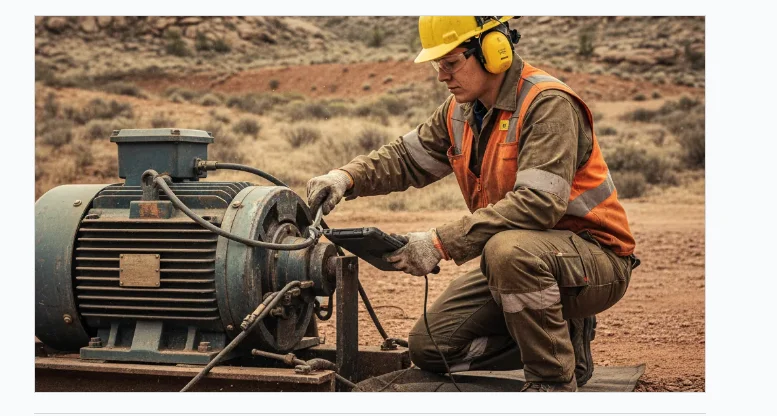
Condition monitoring identifies current equipment issues through real-time data, whereas predictive maintenance utilizes advanced analytics to forecast potential failures weeks or months in advance. The key difference in predictive maintenance vs condition monitoring is the shift from reactive detection to proactive forecasting; allowing industrial teams to schedule repairs before a breakdown occurs. This strategic approach minimizes unplanned downtime and optimizes the overall lifespan of heavy machinery.
Unplanned equipment failures in heavy industrial operations do not just cost money; they cost time, safety, and competitive ground that is difficult to recover. If your operation is running critical assets around the clock, you have likely encountered the frustration of choosing between reactive repairs and maintenance programs that feel either too costly or too complex to justify. The distinction between condition monitoring and predictive maintenance sits at the center of this challenge, and getting it wrong means either over-investing in technology your team cannot act on or under-investing until the next catastrophic failure forces your hand. In this article, you will learn how both strategies work in practice, where each delivers the strongest return in mining and heavy industry, and how to build a realistic path forward for your Canadian operation.
TL;DR: Two Strategies, One Goal
Condition monitoring tracks real-time asset health and fires an alert when a sensor reading crosses a defined threshold; it tells you whether a problem exists right now. Predictive maintenance goes further, using historical trend data and analytics to forecast failures 60 to 90 days before they occur, giving operations teams time to plan shutdowns, pre-order parts, and schedule crews. Both strategies have a legitimate place in heavy industrial operations, and the right choice depends on asset criticality, data maturity, and the operational realities of your site. The sections below break down how each approach works, where each earns its cost, and how to choose between them.
Why the Distinction Matters More in Mining and Heavy Industry

The stakes in Canadian mining, marine, and heavy industrial operations are categorically different from the generic industrial scenarios most maintenance literature describes. A conveyor system feeding a northern Ontario mill or a crusher drive at a British Columbia open-pit mine can carry downtime costs of $20,000 to $80,000 per hour when production stops. At those numbers, the gap between detecting a problem today versus forecasting it six weeks from now is not a technical nuance; it is a budget line item.
Canadian operations compound this pressure with operating conditions that most maintenance frameworks do not account for. Remote mine sites in the Yukon or Northern Quebec may be accessible only by seasonal road or air. Underground environments accelerate bearing wear and create sensor installation challenges that do not exist in a climate-controlled plant. Ambient temperatures that drop below -40°C affect lubricant viscosity, sensor calibration, and equipment thermal signatures in ways that shift monitoring baselines entirely.
Equipment cycles in these sectors also run long. A large drive motor may operate continuously for 18 to 24 months between planned shutdowns. The decision between predictive maintenance vs condition monitoring, in this context, is as much a financial and logistical calculation as it is a technical one.
What Is Condition Monitoring and How Does It Work

Condition monitoring is the practice of continuously or periodically measuring physical parameters that reflect asset health, including vibration, temperature, oil quality, and current draw, and triggering an alert when any reading crosses a defined limit. The question it answers is a specific one: is there a problem right now?
In practice, the workflow is straightforward. Engineers instrument an asset with sensors suited to its failure modes. A large drive motor might carry accelerometers on its bearing housings, a thermal camera watching winding temperature, and a current transducer logging draw patterns. Threshold limits are set based on manufacturer specifications and operational baselines. When a sensor reading exceeds those limits, an alarm fires and a maintenance team investigates. The system is not guessing at the future; it is reporting the present state of the machine.
This is an important distinction from time-based preventive maintenance, which services equipment on a fixed schedule regardless of actual condition. Condition-based maintenance only triggers action when the asset signals a need, which reduces unnecessary interventions and extends service intervals on equipment that is genuinely running well.
What condition monitoring does not do is analyze how a reading is trending over time or forecast when that trend will reach a failure point. That is a different capability entirely, and it is what separates condition monitoring from predictive maintenance. The data collected through CBM is valuable on its own, but it is also the raw material that more advanced analytics require.
What Is Predictive Maintenance and How Does It Go Further
Where condition monitoring stops at the present state of a machine, predictive maintenance picks up with a different question entirely: not whether a problem exists, but when one will occur.
Predictive maintenance extends the condition monitoring framework by layering trend analysis, machine learning models, and historical operating data on top of the real-time sensor feeds that CBM already collects. Instead of firing an alert when a vibration reading crosses a threshold today, a predictive model analyzes how that reading has been drifting over the past several months and calculates a probable failure window. Research from IBM and Tractian both cite early detection windows of 60 to 90 days as achievable with mature predictive analytics programs. That lead time is operationally significant. Sixty days is enough time to plan a coordinated shutdown, source a long-lead replacement bearing or winding component, and schedule a qualified crew to a remote site without emergency freight costs.
It is worth addressing a common framing directly: predictive maintenance is, at its core, an attempt to determine the optimal timing for maintenance activities rather than guessing based on fixed intervals or reacting to failures already in progress. It replaces both the calendar and the alarm with a forecast.
The tradeoff is infrastructure. Predictive analytics require a data platform to store historical readings, software capable of running trend models, and enough operational run time to train those models accurately. A system with three weeks of data cannot generate reliable 90-day forecasts. This is precisely why most operations begin with condition monitoring and build toward predictive analytics as their data matures, treating CBM not as a lesser strategy but as the necessary foundation.
Key Differences: A Practical Comparison for Operations Teams

Understanding the mechanics of each approach is useful; knowing how they compare across the dimensions that drive budget and implementation decisions is what actually moves a site manager toward a choice.
How each strategy uses data. Condition monitoring treats sensor readings as a yes/no question: is the value above the threshold or not? Predictive maintenance treats those same readings as time-series evidence, asking how the value is changing and where that trajectory ends. The data collected is often identical; the difference lies entirely in what the system does with it.
The lead time gap. Condition monitoring typically gives you hours to days between an alert and a required intervention, sometimes less if a failure mode is fast-moving. Predictive analytics extends that window to weeks or months. For a remote northern site where mobilizing a qualified crew takes days and sourcing a long-lead component takes weeks, that difference is the margin between a planned repair and an emergency shutdown.
Implementation cost and complexity. On the question of predictive maintenance vs condition monitoring industrial cost, CBM is the lower-barrier entry point. Sensors, thresholds, and alerting logic can be deployed without a data historian, a machine learning platform, or months of model training. Predictive maintenance requires all of those layers, plus enough historical run data to generate forecasts worth trusting. The upfront gap is real, though it narrows as data infrastructure becomes part of standard site operations.
Matching strategy to asset type. Condition monitoring is well-suited to assets that are accessible, replaceable without extended downtime, or lower in criticality. Predictive maintenance earns its investment on high-value, hard-to-access, or production-critical equipment: large drive motors, primary crushers, conveyor head drives, and marine propulsion systems where an unplanned failure cascades into multi-day production loss and difficult recovery logistics.
When to Use Each Strategy: A Decision Framework for Heavy Industry Sites
The comparison between predictive maintenance vs condition monitoring is well-documented in most maintenance literature. What those resources rarely provide is a concrete framework for deciding which strategy belongs where. Here is one.
Start with condition monitoring as the default. For most heavy industrial sites, and especially those operating in remote locations with limited connectivity or no existing data historian, condition monitoring is the right first move. It requires less infrastructure, delivers immediate value through threshold alerting, and begins building the data record that any future predictive program will depend on. A remote mine site in Northern Ontario or the Yukon with intermittent satellite connectivity is not a viable environment for real-time machine learning models. It is a viable environment for well-instrumented assets with alert thresholds and local data logging.
Upgrade to predictive maintenance when the following criteria apply:
Asset replacement cost exceeds $500K, where the cost of a predictive analytics program is easily justified against one avoided failure event
A single failure leads to multi-day production loss with cascading impacts on downstream operations
The asset sits in a remote or hazardous location where emergency maintenance mobilization is expensive, slow, or dangerous
At least 6 to 12 months of continuous condition data exists to train forecasting models with reasonable accuracy
When all four criteria align, predictive maintenance is not a luxury; it is the operationally responsible choice.
One additional factor worth noting: PMDD motor systems with integrated telemetry and a mechanically simpler drivetrain architecture tend to reach a predictive-ready data posture faster than conventional geared systems, which require longer run histories to separate motor health signals from gearbox noise. That accelerated timeline affects how quickly the upgrade criteria above can realistically be met.
Can Condition Monitoring and Predictive Maintenance Work Together
The answer is yes, and for most serious heavy industrial operations, running both simultaneously is not redundant; it is the intended architecture.
Condition monitoring forms the real-time data layer: sensors measure vibration, temperature, and current continuously, and alerts fire when thresholds are crossed. Predictive analytics sits above that layer, consuming the same data stream over time to build trend models and generate failure forecasts. The two strategies are not competing for the same job. They are sequenced, with each handling a different time horizon.
A useful way to frame it: condition monitoring is the smoke detector. It tells you when something is wrong right now. Predictive maintenance is the fire risk assessment system. It analyzes patterns across months of data to identify which conditions are most likely to produce a fire, and when. You do not choose between them; you run the detector while the risk model matures in the background.
This layered approach is exactly what PMDD motor systems with onboard telemetry are architected to support. Because the drive system outputs clean, continuous data without the signal interference common to geared drivetrains, that single data stream can simultaneously feed threshold-based CBM alerts and the historical trend models that predictive analytics require, without separate sensor installations or parallel data pipelines.
How PMDD Motor Systems Change the Predictive Maintenance Calculus

The layered monitoring architecture described above assumes something that is easy to overlook: the quality and cleanliness of the data coming out of the drive system itself. This is where equipment selection and maintenance strategy intersect, and where PMDD motor systems change the calculus in ways that generic maintenance frameworks do not account for.
Conventional geared drivetrains are maintenance-intensive by design. Gearboxes, couplings, and oil lubrication systems are the failure points that most condition monitoring and predictive maintenance programs are built around. They generate complex, overlapping vibration signatures that require substantial run history to interpret accurately. A predictive model trained on a geared system has to separate motor health signals from gearbox noise, coupling wear, and oil degradation patterns before it can generate reliable forecasts. That signal complexity is a major reason why geared system predictive programs require 12 months or more of data before models become trustworthy.
PMDD motors eliminate those components entirely. No gearbox means no gear mesh frequencies masking bearing signatures. No oil lubrication circuit means no oil degradation trending or seal failure modes to monitor. The vibration and electrical signals coming off a PMDD system are cleaner and simpler to interpret from day one, which compresses the data maturation period significantly. An operation running PMDD drives can reach a credible predictive analytics posture faster, and with less data infrastructure overhead, than an equivalent geared installation.
For remote Canadian sites where data infrastructure is constrained and every monitoring channel carries cost and complexity, that mechanical simplicity is a genuine operational advantage, not a specification footnote.
Getting Started: A Practical Path for Canadian Heavy Industrial Operations

The mechanical advantages of PMDD architecture create a cleaner starting point, but the implementation path still requires deliberate sequencing. Here is a practical roadmap for operations teams working through this decision.
Step 1: Audit and rank your critical assets. Start with replacement cost and production impact. Any asset that costs more than $500K to replace or causes multi-day production loss when it fails belongs at the top of your list, regardless of how old or new your monitoring infrastructure is.
Step 2: Establish baseline condition monitoring on those assets first. Sensors, thresholds, and alerting logic deliver immediate value and begin building the historical record that any future predictive program will require.
Step 3: Allow 6 to 12 months of continuous data collection before evaluating predictive analytics platforms. Models trained on shorter data sets generate forecasts that are not reliable enough to act on.
Step 4: Evaluate your equipment architecture, not just your software. Drive systems that output clean, low-noise data reach predictive readiness faster. PMDD motor systems are worth considering at this stage specifically because they compress the data maturation timeline.
Remote Canadian sites also face two implementation constraints that affect sequencing: intermittent connectivity limits real-time cloud-based analytics, and cold-weather sensor calibration drift can corrupt baseline data if not accounted for in threshold settings. Both are solvable, but they require planning before deployment, not after.
MotiraTech supports this evaluation process through field technical support and a broader review of industrial solutions suited to your site conditions, drive architecture, and monitoring maturity.
Navigating the differences between predictive maintenance and condition monitoring is essential for any heavy industrial operation aiming to maximize uptime. While both strategies offer significant value, the best approach often involves a combination of real-time data and advanced analytics. If you want expert help tailoring a maintenance strategy to your unique infrastructure, our team at MotiraTech is here to support your journey. To dive deeper into these concepts, visit our guide on PMDD Explained for a comprehensive look at modern maintenance practices.