Energy Transition
Mining Technology

PMDD Motors in Mining Conveyors, Crushers, and Ball Mills: Applications and Energy Gains

brooks yee
May 15, 2026
12 min read

PMDD motor conveyor crusher ball mill mining systems significantly lower energy consumption and maintenance costs by replacing traditional gearboxes with high efficiency direct drive technology. These gearless systems provide superior torque control and can achieve power savings of up to 25 percent in heavy duty grinding and transport applications.


If your mine site is still running legacy gearbox drives on conveyors, crushers, or ball mills, you already know the pattern: unplanned downtime, rising maintenance costs, and energy bills that climb faster than commodity prices. These are not minor inconveniences; they are operational risks that compound across every shift. Permanent magnet direct drive technology, or PMDD, has changed the calculation for mining operations worldwide, and Canadian mine sites in particular are seeing measurable gains in energy efficiency, mechanical reliability, and total cost of ownership. In this article, you will learn exactly how PMDD systems function within mining drive applications, where the efficiency numbers stand for conveyors and grinding circuits, how retrofit projects are structured for ball mills, and what to consider when selecting the right PMDD configuration for your specific operation.

What PMDD Technology Actually Does in a Mining Drive System

Permanent Magnet Direct Drive (PMDD) technology removes the mechanical transmission chain that sits between a motor and its driven load. In a conventional mining drive system, that chain typically includes a reducer, fluid coupling, mechanical coupling, and gearbox, each component adding friction losses, maintenance requirements, and potential failure points. PMDD replaces this entire assembly by integrating a permanent magnet synchronous motor directly with the driven equipment.

The mechanical architecture varies by application. In conveyor pulley systems, PMDD uses an outer-rotor structure where the pulley body itself serves as the motor rotor. UH-grade NdFeB permanent magnets are embedded into the inner wall of the pulley, while the main shaft functions as the fixed stator. The result is a single integrated unit with no separate motor frame, no gearbox housing, and no coupling components between the power source and the belt.

This same direct-drive principle extends to crusher and ball mill applications, each with configurations suited to the mechanical demands of those machines. The sections that follow cover each of those three application types with specific performance data.

For readers who want a deeper technical primer on the motor architecture itself, learn more about PMDD technology before continuing.

PMDD on Mining Belt Conveyors: Efficiency Numbers Worth Knowing

Large-scale underground mining conveyor system loaded with ore showing industrial steel framework and scale
PMDD conveyor systems can handle throughput up to 5,000 tonnes per hour at over 96% efficiency.

The integrated outer-rotor structure described above translates directly into measurable performance gains when applied to belt conveyor systems, and those gains matter because conveyors are typically one of the largest energy consumers on a mine site. In open-pit and underground operations across Canada, conveyor systems can represent 30 to 40% of total electrical load. Improving drive efficiency at that scale is not a marginal adjustment; it shifts the energy cost baseline for the entire operation.

The performance data for PMDD conveyor pulley systems gives operations managers concrete figures to work with:

Performance Parameter

PMDD Conveyor Pulley System

Comprehensive system efficiency

Exceeds 96%

Energy consumption reduction vs. gear transmission

18% to 25%

Maintenance interval

20,000 operating hours

Maintenance cost reduction

Over 35%

Power range

11 kW to 2,000 kW

Belt speed range

0.8 to 6 m/s

Maximum throughput capacity

5,000 t/h

For long-distance overland conveyors, PMDD architecture supports distributed drive configurations, meaning multiple direct-drive pulleys spaced along the conveyor route rather than a single centralized drive station. This approach reduces tension peaks in the belt, lowers structural loading on the conveyor frame, and allows individual drive units to be scaled to local grade and load conditions. That flexibility is particularly relevant for Canadian open-pit operations where conveyors traverse variable terrain over several kilometres.

Each PMDD pulley unit is paired with an intelligent variable frequency drive (VFD), which handles soft-start sequencing and continuous speed control. Soft-start capability eliminates the mechanical shock loads that conventional fixed-speed drives impose on belts and splices during startup, extending belt service life. Speed control allows conveyor throughput to be matched to upstream or downstream process rates, cutting idle energy consumption during partial-load periods.

For a capital planning discussion, a 1,000 kW conveyor system running 8,000 hours per year at a 20% efficiency improvement represents approximately 1,600 MWh in annual energy savings before even accounting for reduced maintenance expenditure.

Applying PMDD to Jaw Crushers and Cone Crushers in Mining Operations

Conveyor efficiency improvements are well-documented across the industry. Crusher drive systems receive far less attention, which represents a missed opportunity given how much mechanical complexity and maintenance exposure is concentrated in a typical crusher drivetrain.

Conventional jaw crushers and cone crushers use a combination of induction motors, v-belt transmissions, and gearboxes to deliver torque to the crushing mechanism. Each of those components introduces friction losses, scheduled maintenance requirements, and a potential failure point. PMDD motors eliminate that transmission chain entirely, coupling the permanent magnet synchronous motor directly to the crusher drive shaft. The drivetrain goes from five or more mechanical components in series to two.

The torque density advantage of permanent magnet motors is particularly relevant here. Crusher startup under load is a persistent pain point with traditional induction motors, which struggle to deliver adequate breakaway torque without oversizing. Permanent magnet synchronous motors produce high torque at zero and low speed without the same current surge penalty, which means more controlled starts even when the crushing chamber carries residual material from a previous cycle.

For underground crusher stations, the reduced footprint matters as much as the efficiency gains. Eliminating the gearbox housing and v-belt assembly can meaningfully compress the required installation envelope in a constrained decline or crusher chamber where civil modification is expensive.

VFD pairing adds variable-speed control, which allows crusher throughput to be adjusted in response to upstream feed rates. When ore delivery slows, crusher speed can be reduced proportionally rather than running the machine at full draw against a starved feed. That match between feed rate and drive speed reduces idle energy consumption and lowers mechanical fatigue on the crushing components.

Fewer rotating mechanical components also reduces the probability of cascading drivetrain failure during a production run. A v-belt failure or gearbox seizure can take a crusher offline for hours; a direct-drive system with no belts and no gear mesh has correspondingly fewer modes of sudden mechanical failure.

Ball Mill Retrofit with PMDD: Two Proven Approaches

Engineer examining permanent magnet direct drive motor assembly with copper windings and magnetic components visible
Both pinion-drive and ring-type PMDD retrofits are compatible with existing ball mill installations.

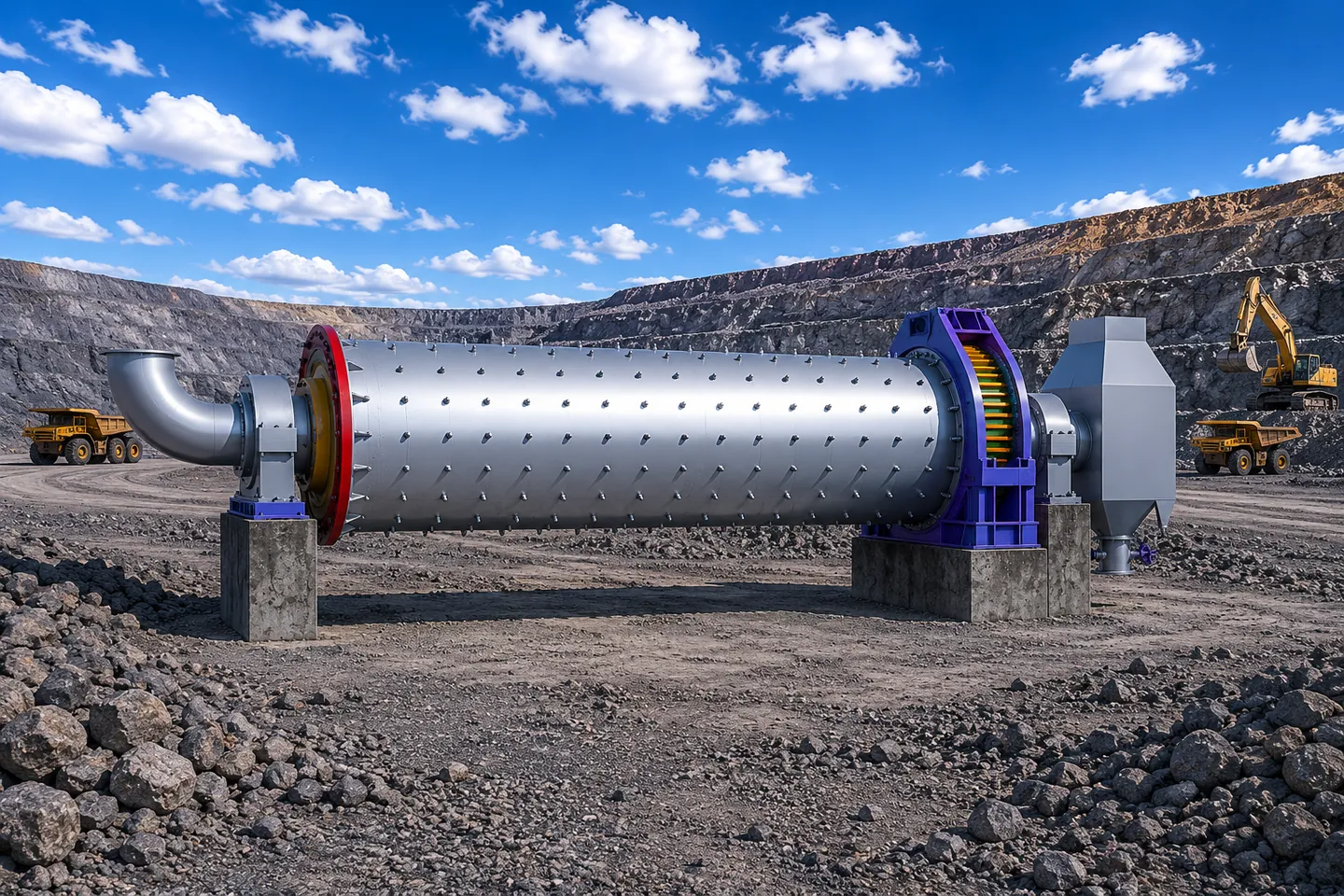
The drivetrain improvements described for conveyors and crushers apply to ball mills as well, but mill retrofits involve a different set of decisions because the mechanical architecture of a rotating grinding drum creates two distinct pathways. Both are retrofit-compatible, which is the critical point for operations looking to improve existing assets without committing to full mill replacement.

Approach one: permanent magnet direct-drive motor replacing the asynchronous motor and reducer, driving the existing pinion. This is the lower-disruption option. The existing mill geometry, including the girth gear and pinion arrangement, stays in place. The asynchronous motor and reducer are removed and replaced with a permanent magnet direct-drive motor sized to the pinion input. No civil or structural modifications to the mill foundation are required. Measured power savings from this configuration range from 12 to 25%, with an average around 17%. For a large grinding mill drawing 3 to 5 MW, that average represents a substantial and immediate reduction in electrical consumption.

Approach two: ring-type permanent magnet direct-drive motor mounted around the mill drum. This is the gearless configuration, where a ring motor integrates directly with the mill shell and the entire conventional drive train, including the reducer, pinion, and girth gear, is removed. The efficiency gains are higher than approach one, consistent with the broader gearless mill drive performance data showing system efficiency above 97%. The capital scope is larger, and the engineering assessment required before installation is more detailed, but the long-term operational profile reflects a fundamentally simpler drivetrain.

For Canadian mines carrying Scope 2 emissions commitments or working toward electrification targets, either pathway contributes directly to reduction goals. A 17% average reduction in mill motor energy draw translates directly into lower purchased electricity consumption, which is the primary input to Scope 2 calculations. Ball mills typically run continuously across multiple shifts, so even a moderate efficiency gain compounds over an annual operating cycle into a meaningful emissions figure.

For operations evaluating which approach suits their site, MotiraTech mining solutions provides application-specific assessments for both retrofit configurations.

PMDD vs Traditional Gearbox Drives: A Practical Comparison for Mining Teams

Disassembled traditional gearbox with multiple components contrasted against a single compact PMDD motor assembly
PMDD reduces the drivetrain from six or more mechanical components in series down to two.

The retrofit and greenfield decisions described above ultimately rest on a direct comparison between PMDD and conventional gear-driven systems. The following breakdown is structured around the four dimensions that typically drive capital decisions at Canadian mine sites.

Energy efficiency

PMDD systems exceed 96% comprehensive system efficiency. Traditional multi-stage gear drives operate between 85 and 90%, with gearbox friction alone responsible for 4 to 7% of that loss before the load ever turns. For a 1 MW conveyor running 8,000 hours per year, closing that efficiency gap by 20% recovers approximately 1,600 MWh annually. Across a site with multiple conveyors, crushers, and a ball mill circuit, those figures compound into a material reduction in purchased electricity and associated Scope 2 emissions.

Maintenance burden

Conventional drivetrains require scheduled lubrication, gear mesh inspections, fluid coupling servicing, and periodic seal and bearing replacement. Each task requires labour, consumables, and planned downtime. PMDD systems carry no gearbox oil, no fluid couplings, and no gear wear surfaces to monitor. Maintenance intervals extend to 20,000 operating hours, and total maintenance cost reductions exceed 35% versus traditional configurations. For remote northern operations where a maintenance crew mobilization is itself a logistical event, that interval difference is significant.

Mechanical complexity

A conventional crusher or mill drivetrain places six or more mechanical components in series between the motor and the load: motor, coupling, fluid coupling, reducer, secondary coupling, and driven shaft. PMDD reduces that chain to two components. Fewer series components means fewer independent failure modes, with the reduction in failure points estimated at approximately 40%.

Operational flexibility

Fixed-speed gear drives cannot easily adjust output to match variable process conditions. PMDD systems paired with VFDs provide continuous variable speed control across conveyor, crusher, and ball mill applications, allowing throughput to track feed rates rather than running at fixed draw against a variable process.

Dimension

Traditional Gear Drive

PMDD System

System efficiency

85 to 90%

Exceeds 96%

Gearbox friction loss

4 to 7%

None

Maintenance interval

Scheduled, frequent

Up to 20,000 hours

Drivetrain components in series

6 or more

2

Variable speed capability

Limited

Full range via VFD

Intelligent Monitoring and Remote Diagnostics in PMDD-Equipped Mining Equipment

Industrial control panel with illuminated digital displays and engineer adjusting monitoring parameters in low light
Integrated telemetry and thermal monitoring enable predictive maintenance without scheduled gearbox servicing.

The efficiency and maintenance interval advantages covered above are measurable in isolation, but their operational value increases significantly when paired with intelligent monitoring systems that can detect developing faults before they become unplanned stoppages.

Modern PMDD systems integrate several complementary diagnostic layers: vibration sensors tracking bearing condition, thermal monitoring on windings and rotor surfaces, current signature analysis through the VFD, and telemetry from the drive controller itself. These data streams feed into remote diagnostic platforms that can be accessed by maintenance engineers off-site, which matters considerably for Canadian mine sites operating in remote northern locations where mobilizing a specialist takes days, not hours.

The absence of a gearbox is directly relevant to diagnostic capability. Conventional drivetrains produce a complex background of gear mesh frequencies, bearing harmonics from multiple shaft speeds, and fluid coupling noise that makes it harder to isolate a developing fault signal. A PMDD drivetrain has no gear mesh, no fluid coupling, and no reducer shaft, so the mechanical noise floor drops substantially. Bearing wear or early winding degradation produces a cleaner anomaly signature that predictive algorithms can identify well before the equipment reaches a failure threshold.

For a remote mine where equipment downtime compounds across the ore haulage schedule, that early detection window is not a convenience; it is the difference between a planned bearing swap during a scheduled shutdown and an emergency extraction of a failed drive unit from an underground crusher station.

MotiraTech's PMDD systems include this intelligent monitoring capability as an integrated component. Readers interested in the data and analytics side of industrial drive monitoring can explore MotiraTech's energy insights for additional detail on how diagnostic telemetry supports operational decision-making.

Selecting the Right PMDD Configuration for Your Mine Site in Canada

Field technician in safety gear performing diagnostics on industrial motor system at remote outdoor mining site
Remote Canadian mine sites benefit most from PMDD's extended maintenance intervals and diagnostic capability.

The monitoring and diagnostic capability described above does not change how a mine operator should prioritize PMDD adoption, but it reinforces the core logic: the value of each application depends on where your site carries the most risk and where the efficiency gap is largest.

Three decision variables tend to separate clear opportunities from more complex ones.

Application type. Conveyors are the most straightforward entry point. The ROI data is well-established, the power range covers most installations from 11 kW to 2,000 kW, and the retrofit process is comparatively low-disruption. Crusher retrofits present a less-documented but equally practical opportunity, particularly for sites where drivetrain failures have historically caused unplanned downtime during production runs. Ball mills carry the highest absolute energy savings potential, but the engineering assessment is more detailed, especially when evaluating the ring-type configuration against the pinion-drive approach.

Site context. Remote northern operations gain disproportionately from the 20,000-hour maintenance interval because each maintenance event involves real logistical cost beyond parts and labour. Sites with Scope 2 commitments can use PMDD energy consumption data directly in emissions reporting, since reduced motor draw maps cleanly onto purchased electricity reductions.

Retrofit vs. greenfield. Both pathways are viable. The two-approach ball mill retrofit framework means that even aging grinding circuits can benefit without full mill replacement, which changes the capital calculus considerably for brownfield operations.

MotiraTech works with mining clients across Canada from its base in Richmond, BC, and provides application-specific technical assessments for all three equipment types. To see how these configurations have performed in practice, view PMDD case studies for deployment detail across conveyor, crusher, and mill applications.


Integrating PMDD motors into mining workflows represents a strategic shift toward energy efficiency and mechanical simplicity. By streamlining power delivery to conveyors and crushers, your operation can achieve higher uptime and lower long-term costs. If you want expert help evaluating these systems for your specific site, our specialized Solutions offer a clear path forward. MotiraTech Industrial Solutions Inc. provides the technical guidance needed to modernize your infrastructure effectively; ensuring your transition to direct drive technology is both seamless and profitable.